
Measurement & Methods
RPM and RCF in a Centrifuge: Why the Numbers Differ
Understand centrifuge RPM and RCF, how rotor radius changes the relationship, and what to record when comparing settings.
Published October 23, 2026
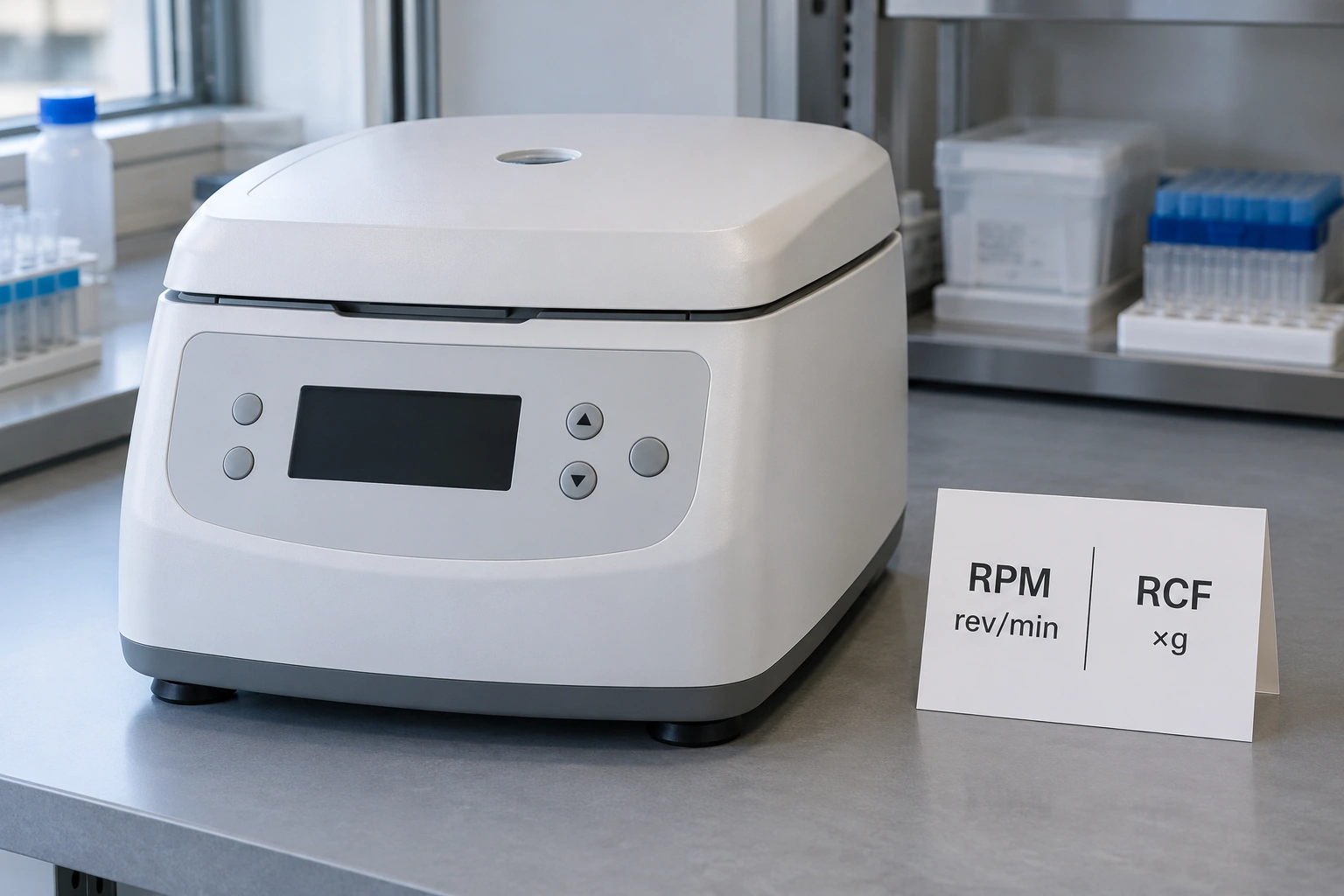
RPM and RCF describe different aspects of centrifugation. RPM is the number of revolutions per minute. RCF expresses the relative effect compared with gravitational acceleration and is written as a multiple of g. Connecting the two requires the appropriate rotor radius.
Consequently, copying an RPM value from one rotor to another does not necessarily reproduce the same RCF. When reading a method or comparing equipment, record units and rotor identity from the start. This article explains the numerical relationship; operation still follows the laboratory method and the limits of the equipment and accessories.
Read the number with its unit
“3,000” alone is not a complete setting. Does it mean 3,000 rpm or 3,000 × g? The values are not interchangeable. An omitted unit can carry an error into the next worksheet or discussion.
Beckman Coulter’s RCF explanation connects RCF with rotational speed and radius. Because radius matters, the centrifuge name alone is insufficient; identify the fitted rotor too.
Separate a brochure’s maximum from the value required by the method. A maximum describes capability under specified manufacturer conditions. It is not a target for every sample. Do not choose a setting merely because it is the largest number available.
Connect radius with relative force
Using radius in centimetres, the relationship can be written:
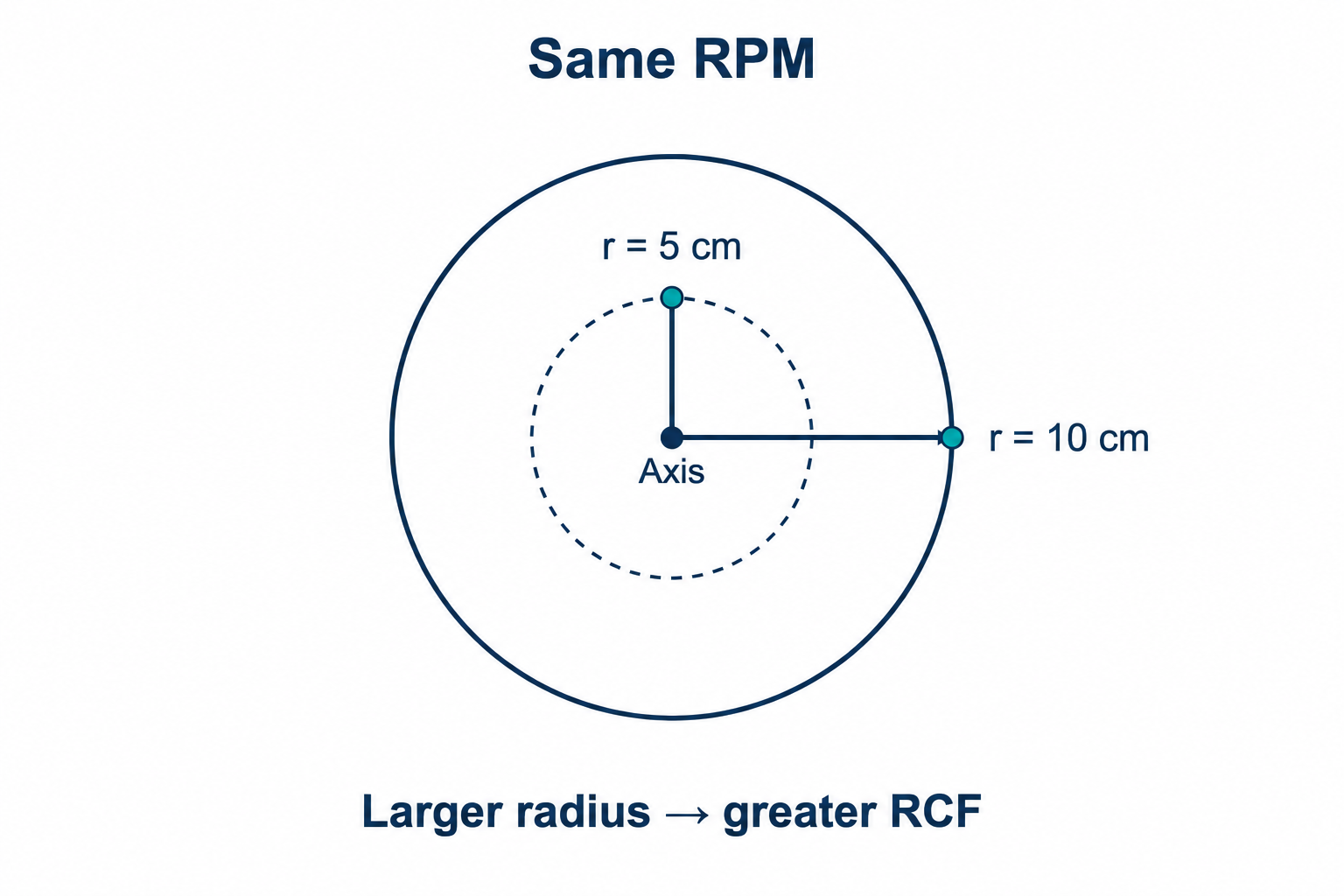
RCF = 1.118 × 10⁻⁵ × r × RPM²
Here, r is radius in centimetres and RPM is revolutions per minute. The Eppendorf P70AT2 rotor manual presents this form of the relationship. Match the radius unit to the formula: a formula using millimetres needs the corresponding coefficient.
As an arithmetic exercise, 3,000 rpm at a radius of 10 cm gives approximately 1,006 × g. At the same speed with a 5 cm radius, the result is approximately 503 × g. These examples demonstrate radius effects rather than recommending settings for a sample.
Identify which radius is meant
A rotor may have minimum, average and maximum radius references. Check its manual for the definitions and published values. Do not casually measure the rotor’s outside edge and assume it is the radius required by the method.
For rotors or accessories with a particular working position, follow the manufacturer’s reference. Adapter and container identity can also matter to the configuration. Retain enough detail for another person to trace the comparison.
If a method specifies RCF without making the relevant radius reference clear, ask its owner for clarification. Filling the gap with a guess can produce a detailed-looking comparison whose underlying basis is different.
Make the calculation readable
Write RPM, radius with its unit and calculated RCF separately. Check unit conversions before entering values. A calculator cannot prevent an error when the radius supplied comes from the wrong reference.
Remember that RPM is squared. A speed change therefore does not produce a linear RCF change. Doubling RPM at the same radius makes the calculated RCF four times as large, rather than twice as large.
Round after calculating with the correct units. Avoid rounding the radius prematurely merely to make it easier to remember. If using a manufacturer’s table or calculator, check that its model, radius and units match the requirement.
Respect the complete configuration’s limits
Understanding the RPM–RCF relationship does not replace checking limits for the rotor, tubes, adapters and other conditions specified in the manual. A value that can be calculated is not necessarily permitted for a particular configuration.
Review time, temperature and other relevant method conditions as well. Matching RCF alone does not establish equivalence of the whole process. Method comparison requires a laboratory owner who understands the purpose and outcome criteria.
Where the display offers both RPM and RCF, learn how the instrument obtains those values. Do not assume it recognises every configuration without correct identification or settings. Follow the model instructions and laboratory procedure.
Retain a record that can be reused
A work record should include the centrifuge, rotor, relevant configuration, setting unit and method reference. If a calculation was performed, retain the radius and its source. The next person should be able to understand the number without repeating the investigation from the beginning.
For procurement, communicate the method requirement with explicit units. Ask about capability with the rotor and accessories that will actually be used, not only the centrifuge’s maximum figure. Confirm which documentation establishes configuration compatibility.
Read how sample preparation affects test results for the wider laboratory context. When consulting Trias, provide the method, capacity needs and existing rotor identity where available. Understanding RPM and RCF makes the specification discussion more precise and easier to verify.